CORS
Cross-Origin Resource Sharing (CORS) lets a web browser and a server determine whether it is safe to allow a cross-origin request. When a browser identifies a cross-origin request, it typically adds an Origin header containing the domain that made the request.
You can configure CORS (Cross-Origin Resource Sharing) at the Gateway level, or for each deployed API on a Gateway. Support for the CORS protocol enables the APIs to circumvent a browser’s same-origin policy, thereby enabling you to implement cross-server, JavaScript-powered API requests.
By using Access-Control-... HTTP headers, CORS allows JavaScript from one origin (server) to request permission from another origin (server) to make API requests.
The API Gateway simplifies this security layer by automatically synchronizing your configurations with the generated OpenAPI Specification (OAS).
Prerequisites
- Access to the Gateway Information settings for your Gateway in API Management.
Configure CORS for a Gateway
Gateway level CORS settings apply to all deployed APIs on the Gateway that do not have CORS settings configured at the API level.
Enabling CORS at the Gateway level applies a global security baseline to every API hosted on that specific Gateway. This centralized approach ensures that all managed services follow a consistent security posture and automatically synchronizes your settings with the generated OpenAPI Specification (OAS).
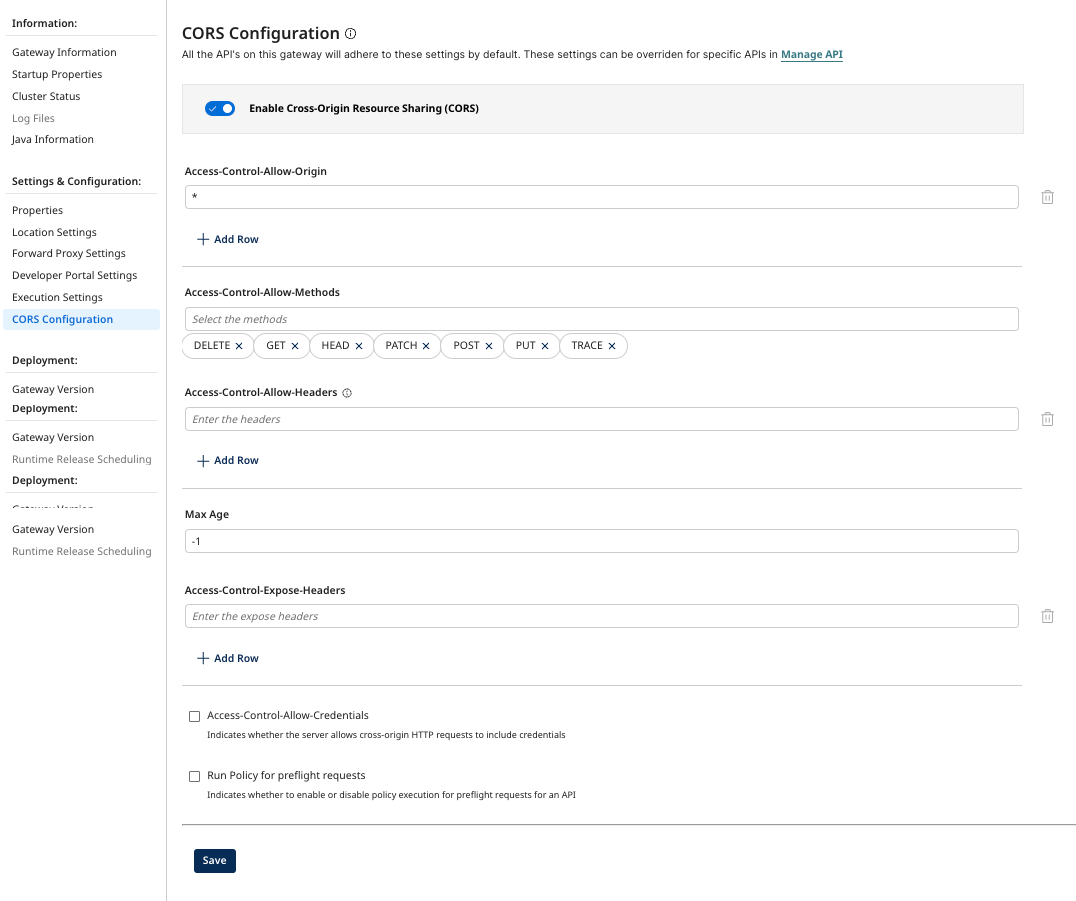
To configure CORS on a Gateway:
-
In API Management, open the Gateway Information settings for your Gateway.
-
Select CORS Configuration.
-
Enable Cross-Origin Resource Sharing (CORS). The following options are available:
- Access-Control-Allow-Origin - List of allowed origins. Default is
*. - Access-Control-Allow-Methods - List of allowed methods. The Gateway supports
DELETE,GET,HEAD,PATCH,POST,PUT, andTRACE. - Access-Control-Allow-Headers - List of allowed headers used in response to a preflight request to indicate which HTTP headers the request can use.
- Max Age - The duration (in seconds) for which the client can cache the results of a preflight request (the information contained in the
Access-Control-Allow-MethodsandAccess-Control-Allow-Headersheaders). - Access-Control-Expose-Headers - Allows a server to indicate which response headers should be made available to scripts running in the browser in response to a cross-origin request.
- Access-Control-Allow-Credentials - Indicates if the server allows cross-origin HTTP requests to include credentials.
- Run Policy for preflight requests - Enable or disable policy execution for preflight requests for an API.
- Access-Control-Allow-Origin - List of allowed origins. Default is
-
Select Save.
Saving these settings triggers an automated update to the generated OpenAPI Specification for all APIs on this Gateway.
The Gateway injects the Access-Control-Allow-Origin header into all 200 (Success) and 400 (Client Error) response definitions. If you disable CORS and redeploy, the Gateway automatically removes these header definitions from the OAS JSON, ensuring your documentation accurately reflects the Gateway's operational state.
Configure CORS for Deployed APIs
For services requiring unique security parameters that differ from the global Gateway policy, use the Manage APIs page to define granular overrides. API-level settings take precedence over any global configurations defined at the Gateway level for that specific API.
To configure CORS at the deployed API level:
-
In API Management, select Configure APIs and Applications > Manage API.
-
Select the API you want to configure.
-
Select the Settings tab.
-
Select Add API CORS.
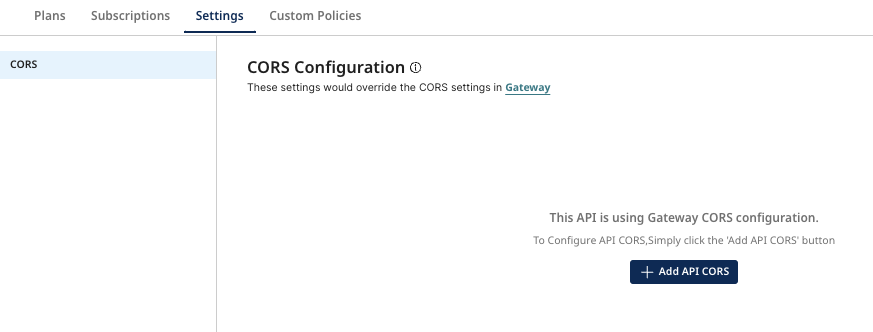
-
The following options are available:
- Access-Control-Allow-Origin - List of allowed origins. Default is
*. - Access-Control-Allow-Methods - List of allowed methods. The Gateway supports
DELETE,GET,HEAD,PATCH,POST,PUT, andTRACE. - Access-Control-Allow-Headers - List of allowed headers used in response to a preflight request to indicate which HTTP headers the request can use.
- Max Age - The duration (in seconds) for which the client can cache the results of a preflight request (the information contained in the
Access-Control-Allow-MethodsandAccess-Control-Allow-Headersheaders). - Access-Control-Expose-Headers - Allows a server to indicate which response headers should be made available to scripts running in the browser in response to a cross-origin request.
- Access-Control-Allow-Credentials - Indicates if the server allows cross-origin HTTP requests to include credentials.
- Run Policy for preflight requests - Enable or disable policy execution for preflight requests for an API.
- Access-Control-Allow-Origin - List of allowed origins. Default is
-
Select Save.
Configuring CORS at the API level directly modifies the generated OpenAPI Specification for that specific service.
The Gateway injects the Access-Control-Allow-Origin header into the 200 (Success) and 400 (Client Error) response definitions within the spec.
CORS on preflight request
A browser running JavaScript uses a preflight request to determine whether it has permission to perform a given action. The browser sends an API request to determine whether the Gateway accepts the HTTP method for that type of request for that API.
Preflight requests must conform with the following requirements:
- Specify the HTTP
OPTIONSmethod. - Include the Origin header.
- Specify the HTTP method for the API request as the
Access-Control-Request-Methodheader value. - Specify the HTTP headers for the API request as the
Access-Control-Request-Headersheader value.
The API Gateway does not authenticate preflight requests. Browsers may cache preflight responses, as the response's Access-Control-Max-Age header value indicates. The Gateway applies any API preflight request policy added using API Policy Manager if you enable the Run policy for preflight requests option in the CORS settings.
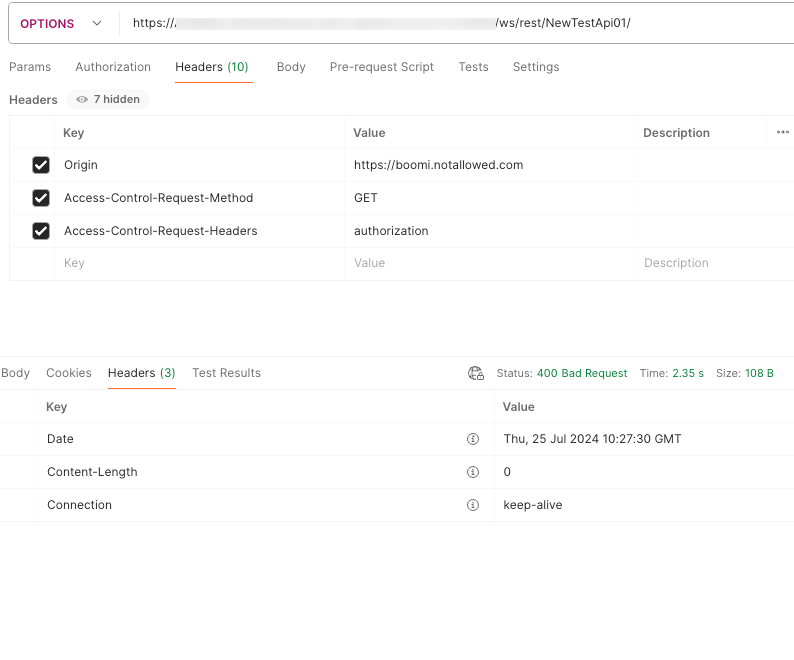
If the Origin, Method, or Header is not allowed in the CORS settings for the API, the preflight request will fail with a 400 BAD Request error. If policies applied successfully for the preflight request, the response status code will be 200, but the response will not include all the Access-Control-... headers.
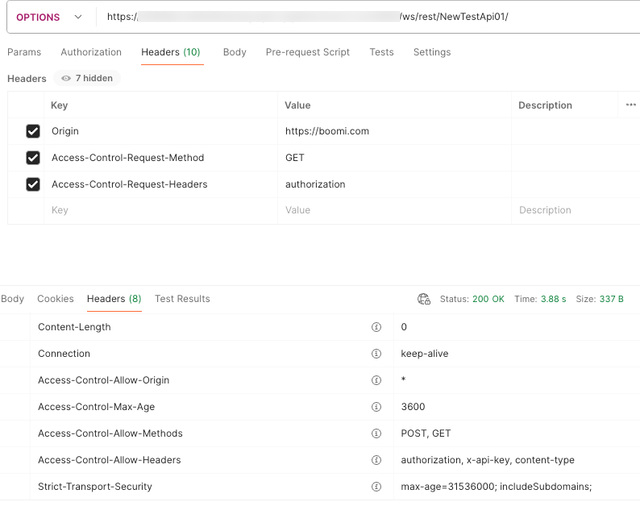
For a preflight request where Origin, Method, and Header are all in the CORS settings allowed list, the response will include the Access-Control-... headers. Access-Control-Allow-Origin will return either * or the origin from the request header. * if Access-Control-Allow-Credentials is false in the CORs settings. Both values notify the client that the CORS settings allow the request origin.
The Gateway adds Access-Control-Allow-Credentials only if you set this to true in the CORS settings.
Preflight requests are not required for cross-origin requests that can be made from a browser without using CORS, such as an HTML form POST.
Preflight examples
The following is an example of an excerpt from a preflight request:
Example where the CORS settings allow ORIGIN, METHODS, and HEADERS:
Example where ORIGIN is not allowed:
CORS on simple/normal request
Some requests do not trigger a CORS preflight. If the response to a preflight request is positive - the specified type of API request from the specified origin is allowed, the browser then submits the normal request.
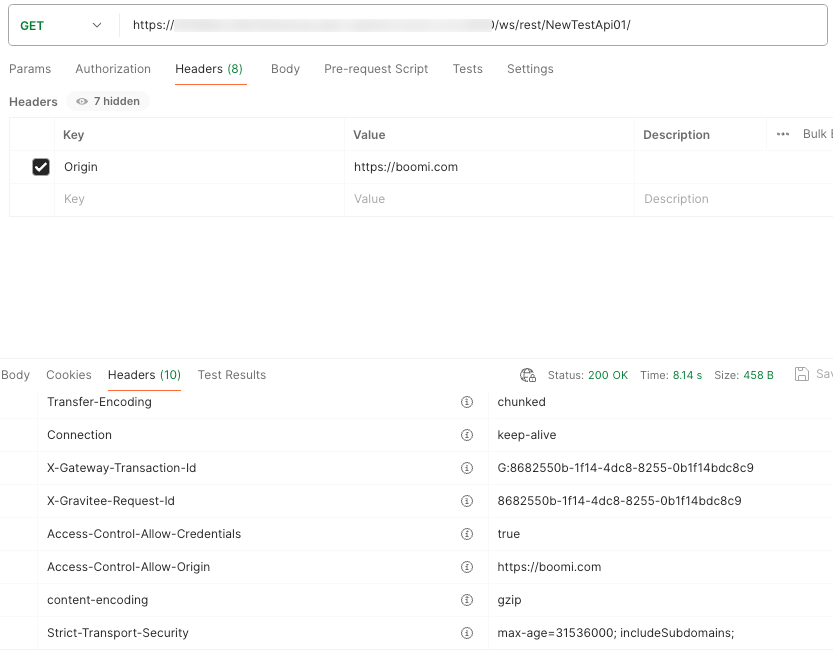
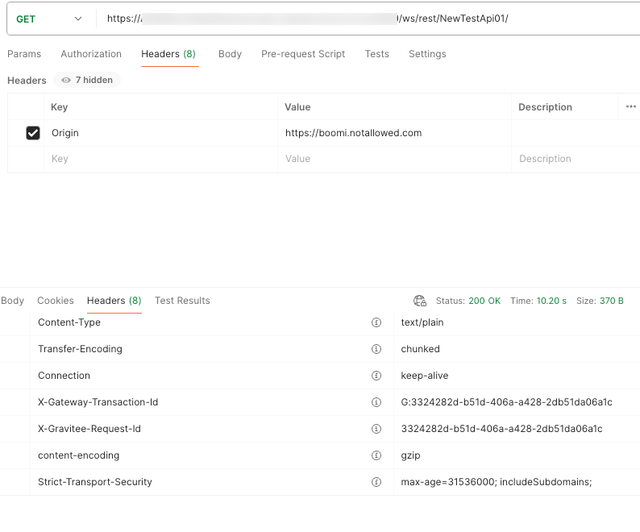
The following is an example of an excerpt from a normal request:
-
Access-Control-Allow-OriginandAccess-Control-Allow-Credentialsheaders are added to the response for Simple/Normal requests. -
Access-Control-Allow-Originresponse header is added only if the request origin is allowed in the CORS settings. -
Access-Control-Allow-Credentialsheader is added only if the requestAccess-Control-Allow-Credentialsis true in CORS settings. If the request's origin is not allowed, the response status code will be200and theAccess-Control-...headers will be omitted. -
Access-Control-Expose-Headersis added if the CORS settings has one or more values inAccess-Control-Expose-Headers.